
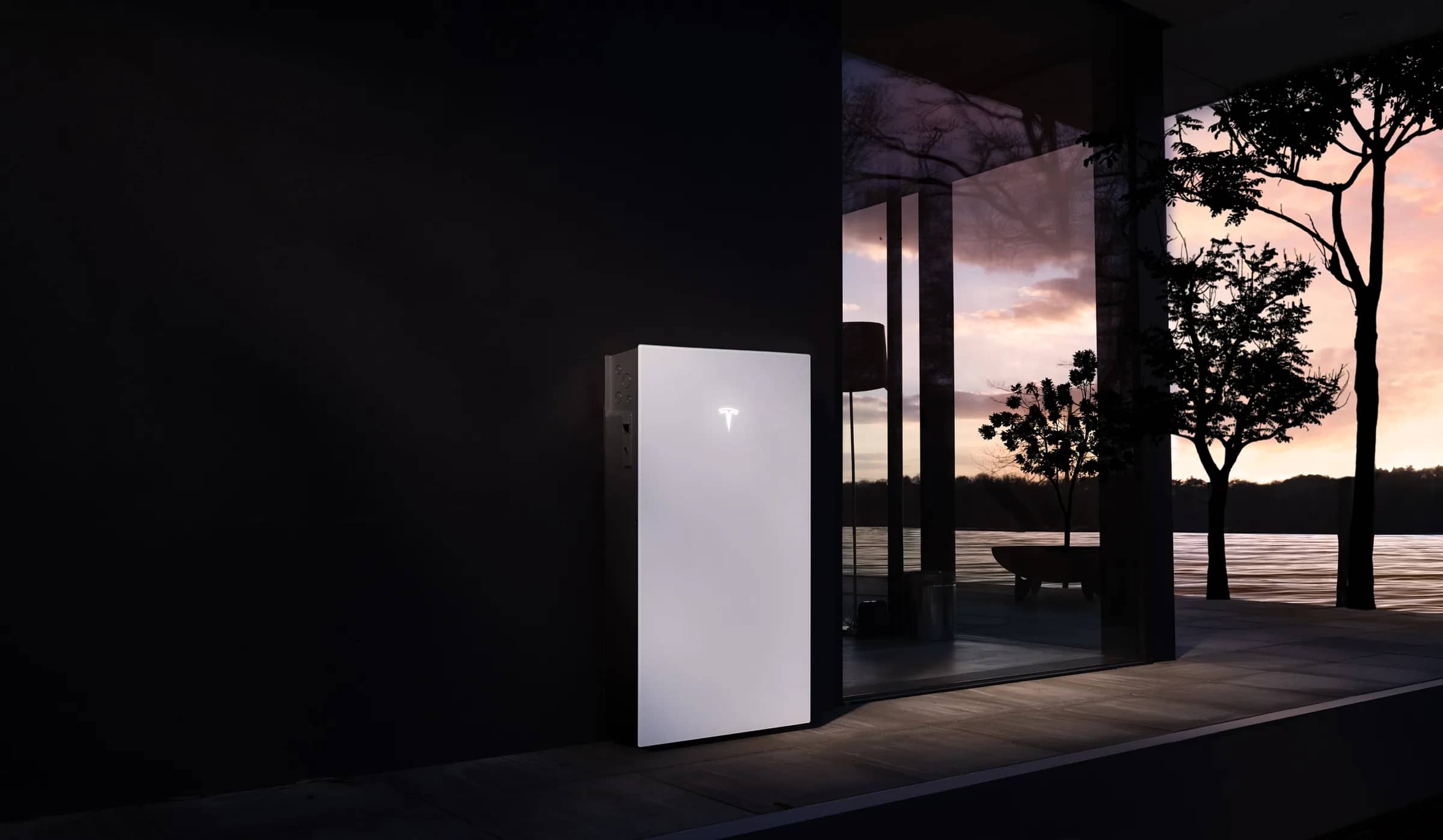

Tesla Powerwall
The Powerwall 3 has the solar inverter built into it, which is why it often works out simpler than it looks on price.
4.7 on Trustpilot

 No obligation
Why people ask for Tesla by name
Newpower is a Tesla certified installer, which is not a badge you buy. The Powerwall 3 is the one people ask for by name, and mostly for the right reasons: 13.5 kWh is a sensible size for a family house, the app is the best in the business, and whole-home backup actually works when the street goes dark.
The thing most quotes do not explain is that the Powerwall 3 has a solar inverter inside it. On a new install that replaces a separate hybrid inverter, so you are comparing one box against two. Once you account for that, the gap between a Powerwall and a cheaper modular battery narrows considerably.
Where it is the wrong answer is a house that already has a working inverter and just wants a few kWh of storage added. Paying for an integrated inverter you are not going to use is money in the wrong place, and we will say so.
- 13.5 kWh usable, which suits most family houses without oversizing
- Solar inverter built in, so a new install needs one box rather than two
- Whole-home backup in a power cut, with a Backup Gateway
- Zero-rated for VAT until 31 March 2027, with or without solar
We are a Tesla installer

The full Tesla range
We fit the whole Powerwall line-up and the Backup Gateway that goes with it, single or stacked. How many you need comes out of what you actually use, not out of a package.
Roughly how the range maps onto real houses:
Powerwall 3
A new solar and battery install, or a house that wants backup.
- Usable capacity
- 13.5 kWh
- Solar inverter
- Built in
- Backup
- Whole home, with a Backup Gateway
- Warranty
- 10 years, with a guaranteed minimum capacity
Powerwall 3 with expansion
Large houses, heat pumps, or anybody charging a car at home as well.
- Capacity
- Stack more than one where the load needs it
- Sizing
- Comes from your half-hourly usage, not your roof
- Backup
- Longer run time through a cut
- Note
- Rarely needed on an average semi
Backup Gateway 2
Anyone who wants the house to stay on when the street goes off.
- What it does
- Disconnects from the grid and runs the house off the battery
- Switchover
- Fast enough that most things do not notice
- Required for
- Whole-home backup
- Note
- Worth it on a rural supply, less so in town
How Tesla compares
| Tesla | A modular battery | Battery only, no solar | |
|---|---|---|---|
| Usable capacity | 13.5 kWh | Start small, add more | Sized to the tariff |
| Solar inverter | Built in | Separate | Not needed |
| Whole-home backup | Yes, with a Gateway | Usually limited or none | Depends on the unit |
| App | The best of them | Varies | Varies |
| Cost per kWh | Higher | Lower | Lower |
| Best for | New installs and backup | Adding to existing solar | Off-peak tariff shifting |
The honest verdict
Why we fit a lot of them
- One box instead of two on a new install, which simplifies the whole job
- Backup that genuinely runs the house, not one socket in the hall
- The app is the one people actually open, which matters for using the thing properly
- Tesla's warranty and support are clear about the capacity you keep at year ten
What to weigh up
- Dearer per kWh than a modular battery, and 13.5 kWh is more than some houses need
- If you already have a working inverter, the built-in one is a feature you are paying for twice
- It is a big unit; there has to be somewhere sensible to put it
- Backup needs a Gateway, which is an extra piece of kit and an extra cost
Questions we get asked about Tesla
Can I have a Powerwall without solar panels?
Yes, and on an off-peak tariff it can make good sense: you fill it overnight at the cheap rate and run the house off it through the day. Batteries are zero-rated for VAT until 31 March 2027 whether or not panels go in with them.
Will it keep my house on in a power cut?
With a Backup Gateway, yes, and it will run the whole house rather than a single circuit. Without a Gateway the battery shuts down with the grid, which surprises people who assumed backup was included.
How long does a Powerwall last?
Tesla warrants it for ten years with a guaranteed minimum capacity remaining at the end. In normal use it cycles about once a day, which is what the warranty is written around.
Is 13.5 kWh too big for my house?
It might be. The right size comes from what you actually use and when, not from the roof. If you are out all day with a car to charge it is about right; if you are home all day using power as you make it, you may be better spending the difference on more panels.
Are you actually Tesla certified?
Yes. Newpower is a Tesla certified installer, which means the training and the sign-off are real and the warranty is not at risk from the installation.


Get a price for a Tesla system.
We come and look at the house, tell you whether this is the right unit for it, and put the price in writing.